
You cannot think your way into a regulated nervous system. Understanding why you feel stuck is a cognitive achievement. However, it rarely reaches the deep, knotted fibers of your psoas or the shallow rhythm of your breath. You might possess a brilliant map of your own history while still feeling like a ghost in your own skin. This is the frustration of the intellectual bypass. It's the gap between knowing you're safe and actually feeling it in your bones. By shifting focus toward somatic grounding techniques, we move away from the noise of the mind and toward the quiet, steady pulse of biological reality.
It's exhausting to live in a body that feels like a foreign territory. We often try to calm down by layering positive thoughts over a foundation of chronic muscle tension. The anxiety remains rooted in the structure. You deserve a connection to yourself that isn't dependent on constant mental effort. This article explores how to cultivate a deeply rooted connection to your physical self. We will examine ways to map internal signals and utilize tools that encourage the release of deep-seated physical tension. The goal is to move beyond surface-level distraction and into a state of genuine structural ease.
Key Takeaways
- Learn to distinguish between mental distraction and true embodiment. Real grounding is a biological act of rooting into your physical reality.
- Master the practice of Signal Mapping. Use interoceptive feedback to navigate your internal landscape and translate vague sensations into clear insights.
- Discover specific somatic grounding techniques that prioritize biological presence. These tools help regulate your autonomic nervous system and build a foundation of safety.
- Identify the "Physical Armor" that creates resistance. Understand why your body might feel anxious during quiet moments and how to prune these obstacles safely.
- Transition from temporary relief to lasting structural ease. Explore how the slow work of biological cultivation leads to a deeply rooted sense of sovereignty.
Understanding Somatic Grounding: More Than Just a Distraction
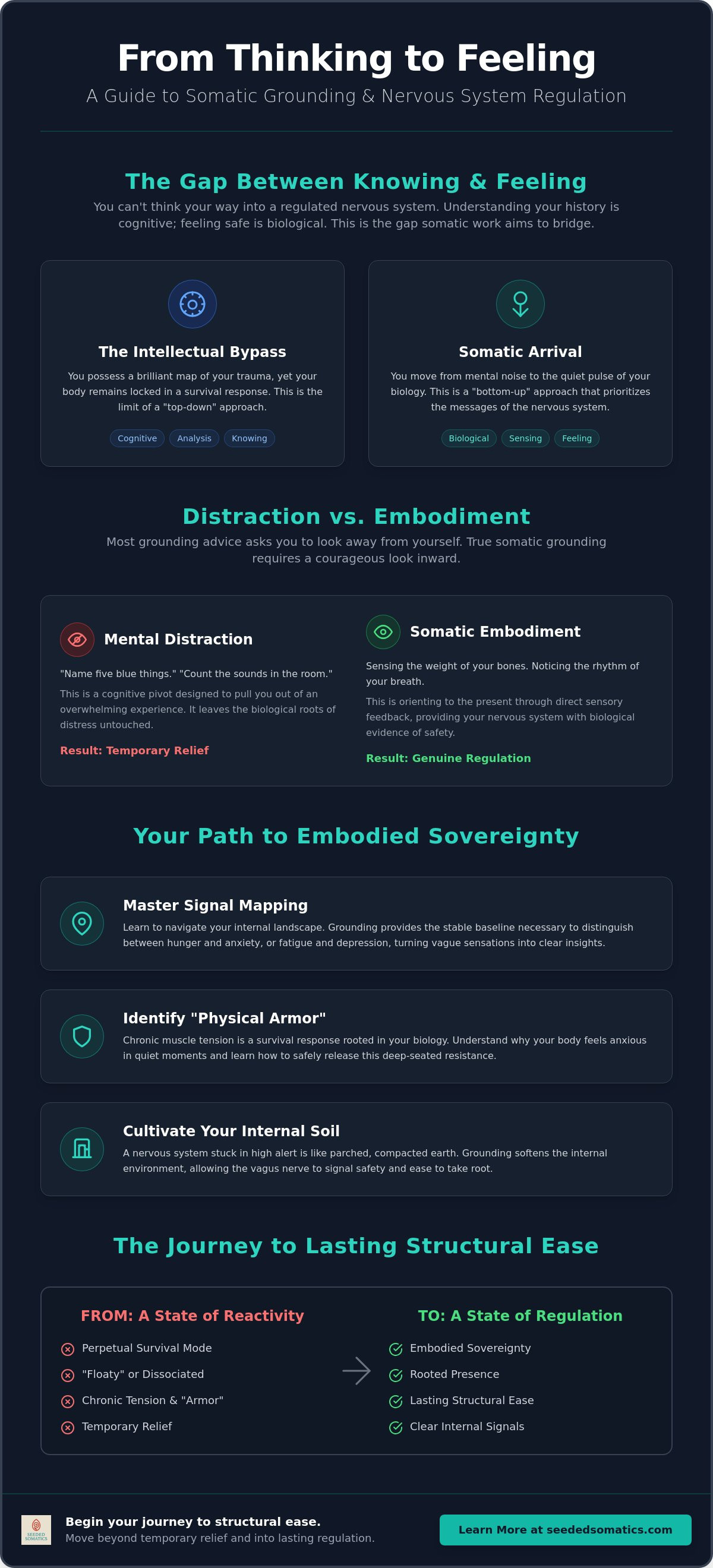
Most grounding advice suggests looking away from yourself. Name five blue things. Count the sounds in the room. This is distraction. It's a cognitive pivot designed to pull you out of an overwhelming internal experience. While helpful in a crisis, it leaves the biological roots of your distress untouched. Effective somatic grounding techniques require a different direction. They ask you to look inward. They focus on the biological process of orienting to the present through direct sensory feedback.
Think of your body as an internal landscape. Physical sensations aren't random glitches. They are the growth of your biological history. If the soil is hard and packed by chronic tension, ease cannot take root. Grounding is the process of tilling that soil. It's the slow work of moving from intellectualizing your stress to experiencing your biological reality. You stop thinking about being calm and start sensing the weight of your bones against the chair. This is the difference between a mental escape and a physical arrival.
The Difference Between Thinking and Sensing
The mind can process the "why" of a trauma while the body remains in a state of high alert. You might understand your history perfectly, yet your psoas remains locked in a survival response. This is the limit of top-down approaches like talk therapy. They address the cognitive map but often fail to reach the biological territory. Somatic work operates from the bottom up. It prioritizes the messages of the nervous system over the narratives of the mind. Somatic grounding is a biological anchor for the nervous system.
Grounding as a Tool for Signal Mapping
When you are dissociated or "floaty," your internal signals become muffled. You can't tell the difference between hunger and anxiety, or fatigue and depression. Grounding provides the stable foundation necessary to identify these bodily signals. It's the baseline. Without a rooted presence, the internal landscape is too noisy to read. These somatic grounding techniques allow you to map your sensations with precision.
In this practice, the goal isn't just to relax. It's to develop the capacity for embodied sovereignty. This involves learning how to transplant sensations of ease from one part of the body to another. A practitioner acts as a guide in this process, helping you recognize where the soil is fertile and where it needs more attention. You move out of a perpetual survival mode. You begin to inhabit your structure with a sense of quiet, sturdy reliability.
The Biology of the Ground: How Your Nervous System Roots
Your nervous system is an ancient, living system. It prioritizes survival over logic. When you apply somatic grounding techniques, you aren't just performing a task; you are communicating directly with your Autonomic Nervous System (ANS). This system operates below the level of conscious thought. It constantly scans for threat. If your body senses danger, your mind cannot simply talk it into peace. You must provide biological evidence of safety. This is the biological reality. The body does not lie about its state of regulation. It either feels rooted, or it feels braced.
Think of this process as cultivating the soil. A nervous system stuck in a state of high alert is like parched, compacted earth. It's too tight to receive new input. Grounding acts as the water and the spade. It softens the internal environment. This shift allows the vagus nerve to signal a state of social engagement and rest. By anchoring your awareness in the physical weight of your body, you provide the ANS with the sensory data it needs to downshift. This is the essential foundation for structural ease.
Interoception and the Internal Compass
Inside the brain, the insular cortex acts as a processing hub for internal signals. This is interoception. It's how you sense the rhythm of your heart, the expansion of your lungs, and the tightness in your gut. Many of us have "silent" zones where we feel nothing at all. This numbness is often a protective response to past overwhelm. Seeding awareness in these quiet areas is essential work. It requires patience. You are learning to map the difference between a signal of true need and the background noise of old stress. If the internal map is blurry, you might benefit from a Signal Mapping Session to help clarify these biological cues.
Fascia and the Architecture of Tension
Your body carries a structural memory. This memory lives in the fascia, the intricate web of connective tissue that wraps around your muscles and organs. When stress is chronic, the fascia thickens. It creates a physical armor. This architecture of tension is a record of every time you had to brace yourself or hold your breath. Grounding techniques help prune this chronic tension by signaling safety to the deeper tissues. Fascia is the biological record of our physical history. Through somatic grounding techniques, we can begin to rewrite that record, moving from a rigid, guarded structure to one of fluid, resilient ease.
Essential Somatic Grounding Techniques for Internal Mapping
Grounding is not a race. It's a slow descent into biological presence. While many popular methods rely on external distraction to pull you away from distress, these somatic grounding techniques prioritize internal resonance. We aren't looking for a way out. We're looking for a way in. This requires a "slow-burn" approach where intentionality matters more than speed. We're moving from survival-based bracing to a state of receptive presence. By anchoring into the body's actual feedback, we begin to transform the internal landscape from a place of threat to a place of resource.
Weight Sensing and Gravity Anchoring
The body often carries a phantom weight. We hold our own pelvic floors, shoulders, and jaws as if we might fall apart without constant effort. Yielding to gravity is the antidote to this chronic bracing. To begin, sit or lie down and notice where your body meets the surface. Instead of just sitting on the chair, let the chair hold you. This is the "Biological Weighted Blanket" technique. You are using your own physical mass to signal safety to the brain. The floor isn't just a surface; it's a partner in your structural ease. As you yield your weight, the architecture of tension begins to soften. You stop performing the act of "holding it together" and start experiencing the support that is already there.
Signal Mapping: Conversing with the Body
Once the weight is settled, we begin the "Scanning the Flora" technique. Imagine your internal sensations as plants in a garden. Some are thorny and sharp. Others are soft like moss or heavy like wet soil. Don't try to change them or pull them out. Simply name their qualities. Is the sensation in your chest hot or cold? Does it vibrate or feel heavy? This is the heart of a Signal Mapping Session. By identifying the texture and temperature of a signal, you strip away its power to overwhelm. You become the observant gardener of the landscape rather than the storm itself. This practice allows you to differentiate between a "noise" of old stress and a "signal" of current need.
Boundary Sensation and Skin Awareness
When we feel "floaty" or dissociated, our sense of self becomes porous. We lose track of where we end and the environment begins. The "Envelope Practice" helps restore this container. Use your hands to gently squeeze your arms, legs, and torso. Feel the boundary of your skin. This self-soothing touch maps the edges of your physical body. It defines the envelope that holds your biological reality. When you know where your boundaries are, the outside world feels less invasive. You aren't just a collection of racing thoughts. You are a biological entity with a clear, defined edge. This reduces the feeling of being "overwhelmed" by external stimuli and restores a sense of internal sovereignty.
Why Grounding Often Fails: Pruning the Obstacles to Embodiment
It's a common frustration. You sit down to practice somatic grounding techniques and, instead of feeling calm, your heart begins to race. You feel a surge of panic. This isn't a sign that you're doing it wrong. It's a sign that your body is doing its job. For many, the internal landscape is guarded by Physical Armor. This is a structural layer of chronic tension designed to protect you from overwhelming sensations. When you attempt to ground without acknowledging this armor, the nervous system perceives the sudden openness as a threat. It braces even harder. We cannot bypass this resistance. We must prune it with patience.
We often try to solve physical problems with mental tools. This creates an overgrowth of intellectualization. You analyze your tension. You research the biology of stress. You build a massive mental library. Yet, the muscles remain tight. The mind is a wonderful tool, but it can also be a barrier to direct experience. True grounding requires us to step out of the library and into the garden. We must move from the "why" of the stress to the "is" of the physical sensation. This shift is the slow work of biological change.
The Trap of Toxic Positivity in Wellness
The wellness space is often cluttered with superficial advice. "Just take a deep breath" is the most frequent offender. For a nervous system stuck in a survival loop, a deep breath can feel like a loss of control. It exposes the vulnerable parts of the torso. This is why we prioritize making space for hesitation. If a part of your body resists letting go, we respect that boundary. We don't force relaxation. We look for deep, structural shifts that happen at the body's own pace. Sovereignty means having the right to say no to a practice that feels too fast.
When the Body Feels Like an Unsafe Neighborhood
Sometimes, the body feels like an unsafe neighborhood. In these cases, the brain uses dissociation as a biological circuit breaker. It cuts off the power to prevent a fire. If you've spent years disconnected from your sensations, coming home to the body can be terrifying. This is where we use titration. You don't dive into the deep end; you take small, manageable sips of sensation. Working with a somatic practitioner provides a co-regulating presence. They act as a steady anchor while you navigate these difficult territories. If you're ready to begin this slow work, a Signal Mapping Session can help you identify where to start pruning the obstacles to your embodiment.
From Grounding to Transformation: The Path of the Somatic Signature Intensive
Grounding is the preparation of the soil. It is the essential first step in reclaiming your internal landscape. However, for many, the goal isn't just to feel temporarily settled. The goal is to live from a place of permanent, structural ease. While somatic grounding techniques provide the immediate anchor you need during moments of distress, lasting transformation requires a deeper level of cultivation. It requires moving beyond the maintenance of the garden and into the active redesign of the ecosystem. At Seeded Somatics, we act as the Wise Gardener for your biological reality. We help you move from simply surviving your sensations to truly inhabiting them.
This process involves a specific sequence of mapping, propagating, and transplanting sensations. First, we map the existing signals to understand where the body is braced. Then, we look for "seeds" of ease. These are the small, often overlooked areas of the body that still feel safe or neutral. Through intentional work, we propagate these sensations. We encourage them to grow. Finally, we transplant that sense of safety into the areas of chronic tension. This isn't a mental trick. It's a biological reorganization. You aren't just practicing a technique. You are changing the way your nervous system perceives its own home.
The Somatic Signature Intensive: A Biological Reset
Weekly movement classes or surface-level exercises have their place. They offer a brief respite. But they rarely reach the deep-seated structural "stuckness" that defines modern stress. The Somatic Signature Intensive is designed for those seeking lasting roots. It is a biological reset. We dive into the layers of Physical Armor that have become part of your identity. The focus is on releasing the deep holding patterns that prevent genuine regulation. By the end of this intensive work, you establish a "Somatic Signature." This is a unique, permanent anchor of embodied ease that persists long after the session ends. It becomes your new baseline.
Starting Your Journey Toward Embodiment
The transition from "coping" with stress to "thriving" in your body doesn't happen overnight. It's a slow, honest process. If you feel ready to move beyond basic somatic grounding techniques, the journey often begins with targeted awareness. A Signal Mapping Session allows you to focus on the specific nuances of your internal landscape. You learn to read the compass of your own nervous system with precision. From there, you can decide when you are ready for the deep, structural shifts offered in our more immersive programs. You deserve a body that feels like a resource rather than a burden. Take the next step toward a deeply rooted biological reality. Explore the Somatic Signature Intensive and begin the work of true transformation.
Cultivating Your Biological Future
Reclaiming your body is a slow, honest process. It requires moving past the intellectual bypass and into the actual fibers of your being. You've learned that somatic grounding techniques are not just tools for distraction, but anchors for your nervous system to find its way back to safety. By mapping your internal signals and respecting the natural resistance of your physical armor, you begin to till the soil for genuine ease. This isn't about superficial relaxation. It's about a fundamental shift in your biological reality. You are moving from a state of perpetual bracing toward a state of receptive presence.
This work avoids the hype of wellness trends in favor of deep, structural change. Led by practitioner Phillip “Obi” Schlachter, Seeded Somatics provides a pathway to lasting transformation that respects the autonomy of your nervous system. If you're tired of feeling floaty or braced against your own life, it's time to build a foundation that lasts. Begin Your Mapping Journey with the Somatic Signature Intensive. You don't have to navigate this internal landscape alone. Your body is ready to return to its natural state of sovereignty and quiet, steady strength.
Frequently Asked Questions
What is the most effective somatic grounding technique for beginners?
Weight sensing is the most accessible entry point for those new to this work. It involves yielding your physical mass to the surface beneath you, whether it's a chair or the floor. Instead of trying to "relax," you simply notice where your body makes contact with the world. This provides immediate biological evidence of support to your nervous system. It's a direct, non-verbal way to signal that you are held by gravity.
Can somatic grounding help with chronic muscle tension or "physical armor"?
Yes, somatic grounding techniques are specifically designed to address the architecture of chronic tension. When you ground effectively, you signal safety to the fascia and the deeper layers of the nervous system. This allows the "physical armor" to soften at its own pace. It isn't about forcing a muscle to let go. It's about creating a biological environment where the body no longer feels the need to brace.
Why do I feel more anxious when I try to ground myself?
This is a common protective response known as "relaxation-induced anxiety." When you suddenly turn your attention inward, you might encounter the very sensations your body has been trying to avoid. Your nervous system perceives this new awareness as a threat to its established defenses. In these moments, it's important to "titrate" your practice. Take small, manageable sips of sensation rather than trying to dive into the deep end of your internal landscape.
How is somatic grounding different from mindfulness meditation?
Mindfulness often focuses on the cognitive observation of thoughts and external stimuli. Somatic grounding is a biological act of rooting into internal and proprioceptive feedback. While mindfulness might ask you to watch your thoughts like clouds, grounding asks you to sense the weight of your bones and the rhythm of your pulse. It is less about witnessing the mind and more about inhabiting the structure of the body.
Is somatic work a form of psychotherapy?
No, the work we do at Seeded Somatics is not traditional psychotherapy. We don't provide mental health diagnoses or insurance-based billing. Instead, we focus on biological education and nervous system regulation. This is a bottom-up approach to structural ease. We work with the body's internal signals to foster sovereignty and resilience rather than analyzing cognitive narratives or past trauma through talk therapy.
How often should I practice somatic grounding to see results?
Consistency is more important than duration. Think of it like watering a garden. Short, frequent "sips" of grounding throughout the day are more effective for the nervous system than one long session per week. Aim for three to five minutes of intentional weight sensing or skin awareness several times a day. This frequent repetition helps prune old stress patterns and reinforces a new baseline of embodied safety.
Do I need a practitioner to do somatic grounding, or can I do it alone?
You can practice basic techniques alone to manage daily stress. However, deep-seated structural shifts often require a co-regulating presence. A practitioner acts as a "Grounded Guide," helping you navigate areas of numbness or intense resistance that are difficult to map on your own. For those seeking a permanent anchor of ease, the Somatic Signature Intensive provides the immersive support necessary for a full biological reset.
What is the difference between a Signal Mapping Session and a traditional massage?
A traditional massage is a passive experience where a therapist manipulates your muscles. A Signal Mapping Session is an active, collaborative process of internal navigation. You aren't just a recipient of touch; you are the explorer of your own sensations. We work together to identify the texture, temperature, and location of bodily signals. This allows you to build a conscious map of your nervous system that persists long after you leave the table.