
Why does your body still carry the weight of a story you've already finished telling? You've done the cognitive work. You understand the "why" behind your patterns. Yet, the jaw remains tight. The breath stays shallow. The tension persists. This disconnect is where non clinical somatic work begins. It isn't about fixing a broken patient. It's about a practitioner and client co-cultivating the biological soil of the body. We work together to allow for true physical sovereignty.
It's exhausting to have intellectual clarity while your muscles remain in a state of stagnation. You've likely tried the talk-only approach and found it wanting. You've felt the frustration of deep-seated tension that yoga or massage cannot reach. You aren't broken; your body is simply communicating in a language your mind hasn't learned to translate yet.
This article shows you how to bridge the gap between understanding your history and actually feeling a sense of ease in your skin. You'll learn how biological mapping transforms abstract concepts into physical reality. We'll explore a non-pathologized way to work with your nervous system and finally understand the signals your body is sending. It's time to move beyond the intellect and into the honest work of physical change.
Key Takeaways
- View your body as a living landscape rather than a problem to be solved. Chronic tension is a protective biological habit; it isn't a mistake.
- Discover why bottom-up processing reaches the deep-seated muscle tension that traditional talk therapy often overlooks.
- Explore how non clinical somatic work utilizes biological feedback to bridge the gap between intellectual understanding and physical ease.
- Learn how Signal Mapping identifies the forensic details of your internal feedback loops to provide a clear path forward.
- Understand how an intensive approach allows for a deep plow of the somatic system to create lasting structural change.
What is Non-Clinical Somatic Work? Defining the Soma
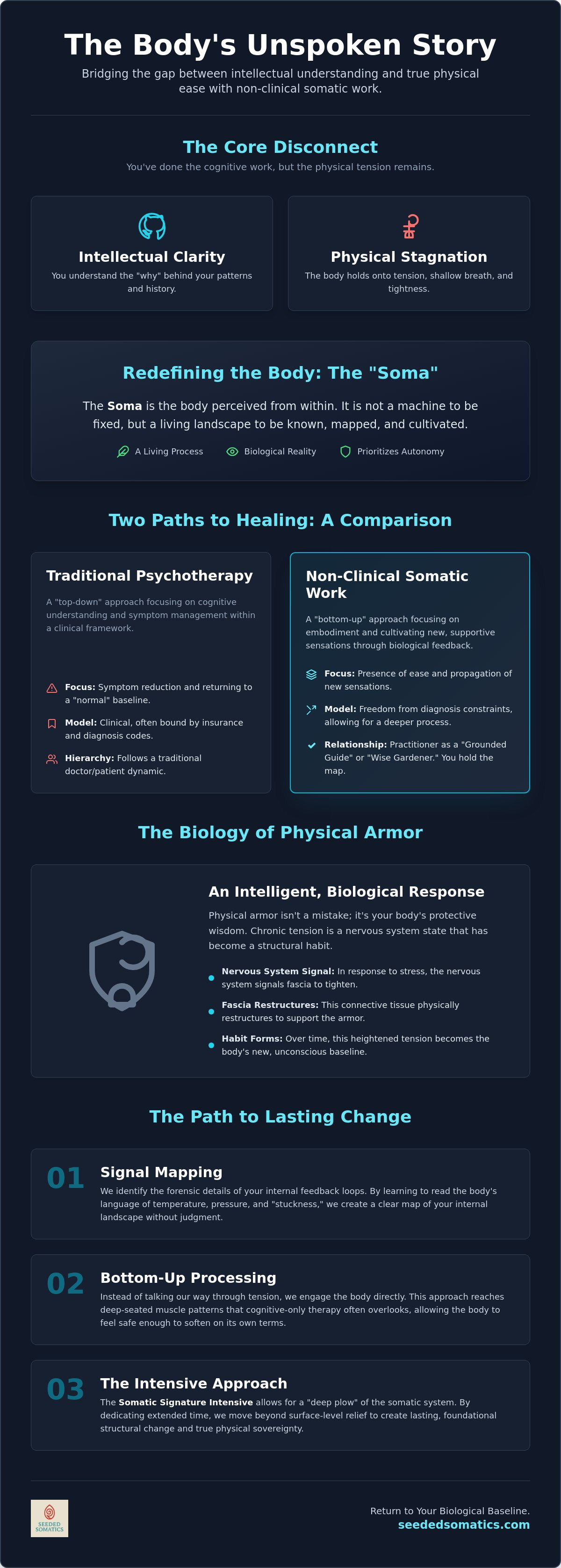
To understand this practice, we must first redefine the body. In this work, we do not view the body as a collection of parts or a machine requiring repair. We look at the "Soma." This is the body perceived from within. It is not an object to be fixed. It is a landscape to be known, mapped, and cultivated. The field of Somatics teaches us that the body is a living process rather than a static entity. When we approach ourselves through this lens, we move away from the coldness of clinical observation and into the warmth of biological reality.
Non-clinical somatic work is the practice of identifying and transforming bodily signals for lasting structural change. It represents a fundamental shift in perspective. We move away from the "mental health diagnosis" and toward "biological feedback." Instead of asking what is wrong with your mind, we observe how your nervous system is currently organized. We look at the soil of your physical experience. We notice where the ground is hard and where it is ready for new growth. This process prioritizes your autonomy. It respects the pace of your own biology.
The Distinction Between Clinical and Non-Clinical Paths
Clinical models often focus on symptom reduction. They seek to bring a patient back to a baseline of "normalcy." This is necessary work, but it is different from what we do here. Non clinical somatic work focuses on embodiment and the "propagation" of new, supportive sensations. We aren't just looking for the absence of pain. We are looking for the presence of ease. Because we operate outside of the insurance-based, medicalized model, we aren't bound by the constraints of a diagnosis code. This freedom allows for a deeper, more intentional process. It makes space for the Somatic Signature Intensive, where we can spend hours instead of minutes tending to the deep roots of your physical experience.
The Role of the Somatic Practitioner as a Grounded Guide
In this space, the hierarchy of doctor and patient disappears. I do not hold the map to your body; you do. I act as a "Wise Gardener" or a grounded guide. My role is to help you prune away the old patterns of tension that no longer serve you. Together, we seed a new sense of presence. This requires a safe, non-judgmental container. Your body has reasons for its resistance. It has reasons for its armor. We don't force those defenses down. We wait for the body to feel secure enough to soften on its own. Through a Signal Mapping Session, we begin the slow work of recognition. We listen to the signals. We respect the timing of the seasons. We wait for the internal shift that leads to sovereignty.
The Biology of Physical Armor: Understanding Your Internal Ecosystem
Physical armor is the body’s intelligent, biological response to past stress. It is a protective overgrowth. Think of a tree that thickens its bark on the side facing the prevailing wind. It isn't a mistake. Chronic tension is a nervous system state that has become a structural habit. The body is simply doing what it was designed to do: survive. When the environment feels unsafe, the body builds a fortress. This is biological wisdom, not a malfunction.
This process involves both the fascia and the nervous system. Fascia is the connective tissue that wraps around every muscle and organ. When we experience stress, the nervous system signals the fascia to tighten. Over time, this tightness becomes the new baseline. There is a clear neurophysiological rationale for why these patterns persist long after the threat has passed. The tissue literally restructures itself to support the armor, creating a physical container that mirrors your past experiences.
You cannot force a flower to bloom; you can only prepare the soil and wait for the roots to take. In non clinical somatic work, we don't attack the tension. We don't try to "break" the armor. We look at the ecosystem that created it. We ask the body what it needs to feel safe enough to let go. This is the slow, honest work of cultivation. We are not fixing a machine; we are tending a garden.
Deciphering the Nervous System’s Signal Language
Your body speaks in a language of temperature, pressure, and "stuckness." These are not symptoms to be silenced. They are signals to be read. Through interoception, we develop the biological sense that allows us to map our internal landscape. We move from a place of reaction to a place of recognition. We stop fighting the signal and start understanding the message. A Signal Mapping Session provides the quiet space needed to begin this forensic study of your own internal feedback loops. It is the first step toward sovereignty.
Why Intellectual Understanding Isn’t Enough for Physical Change
Many people find that their mind is "over" a situation while their psoas remains tight. This is the biological lag between cognitive processing and nervous system regulation. Your thoughts move fast. Your biology moves slow. Physical change requires a direct conversation with the nervous system, not just a mental analysis of its history. You can't think your way into a regulated state. You have to feel your way there. This is the core of non clinical somatic work. It bridges the gap between what you know and what you actually experience in your skin.
Non-Clinical Somatic Work vs. Traditional Psychotherapy
Traditional psychotherapy often approaches the human experience from the top down. It prioritizes the mind. It seeks clarity through narrative and intellectual insight. This is valuable work. However, for many, there is a limit to what conversation can achieve. You can understand the "why" of your anxiety perfectly while your heart still races. You can process a memory cognitively while your shoulders remain pinned to your ears. This is the biological lag between the mind's understanding and the body's safety.
non clinical somatic work flips the direction of the conversation. It is a bottom-up approach. We don't start with the story; we start with the sensation. There is a profound difference between "talking about" a feeling and "mapping" that sensation in real-time. Talking about tension is a mental exercise. Mapping tension is an act of forensic observation. We look at the pressure. We notice the temperature. We track the movement of the signal through the fascia. We are no longer discussing the past. We are tending to the present biological reality.
This work intentionally avoids the "patient" label. In a clinical setting, there is often a hierarchy. There is a person who is "broken" and a professional who "fixes" them. We reject that model. You are not a patient to be cured; you are a sovereign individual with a body that has adapted to its environment. By removing the pressure of a mental health diagnosis, we foster a sense of self-authorship. You become the primary authority on your own internal landscape.
When to Choose a Somatic Approach
Many people arrive at this work after hitting a plateau in traditional talk therapy. They feel "over-analyzed." They have the vocabulary for their struggles, but their physical experience hasn't changed. If you are seeking structural ease or the release of deep-seated muscle tension that massage cannot reach, a somatic approach is often the missing piece. It is for those who want a practice that integrates movement and biological feedback into their healing journey. It is for the person ready to stop talking about the soil and start planting the seeds.
The Synergy of Mind and Body
This is not an "either-or" choice. Somatic work often acts as a powerful complement to existing therapeutic practices. It creates the fertile ground where intellectual insights can finally take root. When the nervous system is regulated and the body feels safe, the mind can process information with greater clarity. We move from "processing" a concept to "embodying" a new way of being. This transition is where lasting transformation lives. It is the shift from knowing you are safe to actually feeling safe in your own skin.
A Signal Mapping Session is the forensic study of your own internal feedback loops. It is an unhurried process. We do not rush toward a result. Instead, we begin with a slow-burn recognition of what is currently present in the body. We sit with the "stuckness." We observe the vibration. This is where we identify your Somatic Signature. This is the unique, structural way your system organizes itself around stress and safety. In non clinical somatic work, the goal is never to simply "fix" the signal. If we try to silence the signal, we lose the message. We seek to understand where the signal came from and why the body continues to send it. By understanding the origin, we can begin to cultivate a different path. We offer the nervous system an alternative to its habitual bracing. It is the difference between pulling a weed and understanding why the soil was predisposed to grow it in the first place.Identifying the Roots of Tension
We use guided somatic exploration to find the "edges" of your physical armor. We look for the boundary where softness meets resistance. This requires distinguishing between different types of biological feedback. There are "loud" signals, such as acute pain or sharp tension. These are the shouts of the system. Then there are "quiet" signals. Numbness, coldness, or a subtle sense of bracing are often the most important data points. They are the body’s way of saying "not yet." My role as a practitioner is to provide a grounded presence. I mirror your state without judgment. This mirroring allows your biology to feel less alone in its resistance. It is often the first step toward a natural softening.
From Mapping to Transformation
Once a signal is mapped and understood, the nervous system often begins to down-regulate. The armor doesn't have to work so hard when it is no longer ignored. This is where transformation begins. We engage in the practice of "transplanting" ease. If your hands feel relaxed but your chest feels tight, we learn how to propagate that sense of comfort from one area to the other. We are moving the "living water" of ease to the parched areas of your biology. You aren't just learning a technique. You are building a personalized map for daily embodiment. You are learning the specific seasonal shifts of your own internal ecosystem.
If you are ready to begin this forensic study of your own internal landscape, you can book a Signal Mapping Session to start the process of recognition and structural change.
The Somatic Signature Intensive: Cultivating Lasting Ease
Weekly sessions are like light rain. They provide temporary relief. They keep the surface moist. But for deep, structural change, we need a deep plow. The Somatic Signature Intensive is designed for this specific depth. It moves beyond the limitations of the one-hour container. We reach the layers of the somatic system that weekly sessions often miss. This isn't just about feeling better for a day. It's about a permanent shift in your baseline nervous system state. We aren't looking for a temporary reprieve from the storm. We are looking to change the climate of your body.
In non clinical somatic work, we don't just identify tension. We map it. We propagate new sensations. We transplant ease from where it lives to where it is needed. Think of it as irrigation for your internal landscape. If your breath is shallow but your feet feel grounded, we learn to move that groundedness upward. We don't just talk about the possibility of ease. We physically move it through your system. This is how we create structural change. The Intensive is a biological reset that fosters a state of embodied sovereignty.
Why an Intensive Format Yields Deep Roots
The nervous system needs time to settle. Most of us live in a cycle of "stress-relax-stress." We find a moment of peace, only to be pulled back into the fray. This staccato rhythm prevents deep healing. Immersion breaks this cycle. Sustained focus allows the biology to recognize safety as a steady state rather than a fleeting exception. When we stay with the body for an extended period, the "biological armor" we discussed earlier has the chance to truly soften. We are creating the capacity for lasting, structural ease. We are going deep into the soil. We are ensuring the roots have space to spread. It's the difference between a quick pruning and a total garden restoration.
Seeding Your Future Self
The work at Seeded Somatics isn't just about the session. It's about the harvest. We help you cultivate a new way of being in the world. You learn to recognize the signals before they become screams. You learn to tend to your own nervous system with the skill of a master gardener. This is the transition from surviving to thriving. It's for those ready to move beyond the plateau of talk therapy. It's for the person who wants to feel the weight of their own authority. You don't need a diagnosis to deserve ease. You only need a body and a willingness to listen.
Ready to map your embodiment? Explore the Somatic Signature Intensive with Seeded Somatics.
Returning to Your Biological Baseline
The path to ease is not found in more analysis. It is found in the soil of your own experience. You've seen how your body carries its history as structural armor. You've understood why talk therapy often plateaus when it meets the stubborn resistance of the fascia. This is the heart of non clinical somatic work. It is a return to biological reality. We move away from abstract theories and into the direct, unhurried feedback of your nervous system.
Led by practitioner Phillip “Obi” Schlachter, Seeded Somatics prioritizes biological mapping over "woo-woo" spiritualism. We utilize specialized intensive formats to reach the deep, structural layers that weekly sessions often miss. You aren't broken. You're simply organized for a past that is no longer happening. It is time to reclaim your internal authority and seed a new way of being in the world. The ground is ready for change. Book a Signal Mapping Session with Seeded Somatics to begin your journey toward embodied sovereignty.
Frequently Asked Questions
Is non-clinical somatic work the same as massage or bodywork?
No, this practice differs fundamentally from massage. While a massage therapist manipulates your tissue from the outside, non clinical somatic work focuses on your internal perception of your own biology. We are not just rubbing muscles to induce temporary relaxation. We are mapping the nervous system's signals and learning to read the language of your internal ecosystem so you can achieve lasting structural change.
Can I do somatic sessions if I am currently in talk therapy?
Yes, these practices often work in harmony. Talk therapy addresses the narrative and cognitive "why" of your experience, while somatic work tends to the physical soil where those experiences are held. Many clients find that somatic sessions provide the fertile ground needed for their intellectual insights to finally take root in the body. It bridges the gap between knowing you are safe and actually feeling it.
How many Signal Mapping Sessions do I need to see results?
Every internal landscape has its own rhythm and history. Some individuals experience a shift in their physical baseline after a single Signal Mapping Session, while others require a series of sessions to establish a new sense of safety. We don't rush the process. True, structural shifts require the unhurried cultivation of your nervous system's capacity to hold ease.
What happens if my body resists the somatic process?
Resistance is not a mistake; it is a protective biological defense. We don't force our way through your physical armor or try to "break" the tension. Instead, we sit with the resistance and map its edges. We treat it as an intelligent response to past stress. By acknowledging the body's need for protection, we create the safety required for the system to eventually soften on its own.
Is this work appropriate for releasing trauma stored in the fascia?
This work addresses the biological reality of how the body carries its history. While we do not operate within a clinical mental health model, we work directly with the nervous system states that manifest as tension in the fascia. We focus on the forensic study of your internal signals. This allows your system to down-regulate and release the "stuckness" that talk-only approaches often miss.
How does a Somatic Signature Intensive differ from a standard coaching session?
The Somatic Signature Intensive is a "deep plow" of your somatic system. Standard coaching often stays at the level of mindset and goals, but an intensive focuses on the structural organization of your biology. It is a sustained immersion designed to break the cycle of chronic stress. This format reaches the deeper layers of the nervous system that a standard one-hour session cannot access.
What should I wear or bring to a somatic mapping session?
Wear comfortable, unrestrictive clothing that allows your breath to move freely. You don't need any special equipment or tools. Bring a willingness to be unhurried and observant. The session is a slow-burn exploration of your internal feedback loops, so it's best to arrive in a state that prioritizes your own physical comfort and presence.
Can non-clinical somatic work help with chronic physical tension?
Yes, non clinical somatic work is specifically designed to address the deep-seated tension that massage or yoga often fails to reach. We view chronic tension as a nervous system habit that has become a structural reality. By mapping the signals of temperature, pressure, and bracing, we help your body find its own path back to a state of ease and physical sovereignty.